
Planting Guide
Dial Before You Dig

This is an Australia-wide community service: a unique partnership between our telecommunications, electricity, gas and water providers to protect costly underground pipes and cables. Protect yourself and your assets simply by dialling 1100 Before You Dig or visiting byda.com.au.
This is a FREE service.
Root-bound plants
Get a clean sharp knife or sharp spade and cut about 25–50 mm (1–2 inches) off the base of the root ball, and also cut vertical slits 25 mm (1 inch) deep in the root ball around the circumference. Clean sharp cuts encourage new roots to grow from the ball.
Removing bags from trees
- Before removing the bag from the tree, lean the tree over and with a sharp knife cut across the bottom of the bag and 150 mm up each side.
- Loosen the bottom of the bag from the roots.
- Position the tree at its best aspect before placing it in the hole.
- Using the bag handles, place the bag in the prepared hole after making sure that the hole is the correct depth. The existing soil level in the bag should match the soil level of the garden or lawn (no more than 50 mm below if required for watering).
- Complete the cuts up both sides of the bag and remove the two halves.
- Lightly trim or tip-prune roots that are circling the bag.
- Backfill, fertilise and water thoroughly. Ensure the filling is firm.
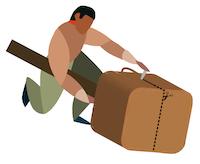
Moving bags without a suitable trolley
Up to 150 litre size bags can be manoeuvred by hand (elderly people are exempt). If possible, water the ground (concrete, grass etc.) as a lubricant, then take the two handles that are closest together and drag left, right, left, right in a zigzag fashion. You will be surprised how easy it is.
Shrubs and trees from 25 litre+ bags
Plants can be planted out most times of the year, provided the following points are followed.
Drainage
If the soil is not well drained it is advisable to make a circular mound 1.5 metres across and 20–30 cm high (or bigger for trees in bags greater than 100 litres). This can be achieved by bringing outside loamy soil to the planting site, or alternatively mound the existing soil. Do not plant in holes in heavy clay soils unless an adequate drain extends from the hole. The hole will act like a sump and the plant's roots will become waterlogged. To determine the drainage rate, fill your hole with water prior to planting the tree and gauge how long the water takes to drain away.
Water before planting
The plants should be watered thoroughly several hours before planting to moisten the root ball. Planting out with the root ball dry or partially dry will result in roots being damaged and poor establishment. The planting site should also be thoroughly watered the day before planting.
Planting
Make a hole in the soil or mound as recommended in our bag sizes guide. Cut the bag from the plant, lightly tease roots down the side of the root ball and loosen any matted roots at the base of the root ball. Fill in soil around the roots, making sure not to plant the root ball any more than 2 cm lower than it was in the bag. Plants will suffer if planted too deep. Soil should be firmed down well after planting. At least 20 litres of water (for 25 litre bags, and more for larger bags) should be applied to each tree to settle the soil around the roots. A saucer-shaped depression 50 cm in diameter will help hold water when watering in.
Digging the hole
Digging your hole is probably the least desirable job when planting advanced trees. However, other means are available. The best idea is to get someone else to dig it for you; ask us about the tree planters we work with.
If you can get a machine to the planting spot, the correct machine to use is a small excavator, preferably on rubber tracks. These are readily available as a combination with bobcats from several private contractors and hire companies. The bobcats are also useful to transport the trees and remove excavated material that isn't required.
Another helpful machine is a mechanised posthole borer. These are also available from your local hire companies, with various sized augers. I would use a 200 mm auger or less and drill a number of holes in your planting spot as close together as possible, then remove the balance with a sharp spade.
Sometimes when you are digging in very hard ground, it helps to space the digging over a couple of days and keep filling the hole with water overnight. Always keep in mind that a crowbar with a sharp, spade-like end is probably the most important tool for hand digging holes in hard ground.
Of course, always check where underground services are located before digging. See Dial Before You Dig at the top of this page.
When digging a hole, make sure that the walls are not an even shape. You don't want to form another pot that drives the roots into a larger “pot” shape. If using a posthole borer, roughen the walls of the hole with a crowbar or pick so the roots have a chance to penetrate the walls. Make sure that the walls are misshapen.
Fertilising
Applying a slow release fertiliser at planting will help young plants off to a good start. This can be applied by scratching it into the surface around the young tree.
Staking
Plants are better off not staked, but if needed use two wooden stakes, one on each side of the tree (30 cm from the tree), and tie the tree to these stakes using old pantyhose or similar material.
Mulching
Mulching the plants with old straw, hay etc. will stop the soil from drying out and heating up, stop weeds from germinating, and also add valuable organic matter. Do not apply mulch against the plant as collar rot may occur. Plants that are susceptible to frost damage are better off without mulch during the winter months, the reason being that bare soil kept moist will absorb heat during the day and radiate this heat at night, reducing the severity of frost.
Choosing the right species
The correct selection of species for each particular site is critical to success. Added to this, if the ground is prepared correctly, i.e. fertiliser and water are available, all of the species we grow will grow well in our subtropical climate.
More guides
All resources →- Plant Care & Pest ControlWeed control, feeding, mulch, watering and pruning after planting, plus how we manage common pests.
- Watering InformationTree watering bags, greywater tips and which laundry products are safest for your garden.
- Safe Planting Near PowerlinesEnergex clearance guidance and the trees Brisbane City Council plants under powerlines and on footpaths.